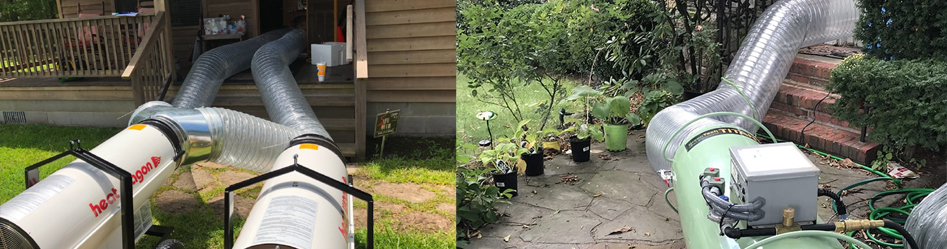
When exposed to temperatures of just less than 100° F, an insect’s growth will slow. At temperatures of 100° F to 120° F, it will die in a day. Above 120° F, an insect will die in minutes. That’s a simple enough concept, and, in fact, the simple principle behind the pest management method of thermal remediation.
FUMIGATION ALTERNATIVE. Thermal remediation, or more simply heat treatment, is the process of gradually heating a structure or equipment to temperatures high enough to kill insects or other pests living or breeding within. It can provide a viable alternative to fumigation for empty structures, eliminating infestations or carry-over insect populations of previous years, which can infest newly stored product. Heat has, in fact, been used to control insects in structures since the early 1900s, with major food and grain companies successfully using heat for insect management over the last 50 years. With the Montreal Protocol ordering the phase-out of methyl bromide in recent years, interest in — and the availability of — heat as a fumigation alternative has grown.
The complexity of the technique has to do with effective distribution of the heat, the mobility of insects, the sensitivity of products and some equipment to high temperatures, and the insulating nature of commodities and debris. However, there are significant advantages to using heat for pest management, including the facts that high temperatures kill all life stages of the insect; it is non-pesticidal, so it can be used in organic-production plants; and unlike fumigation, specific areas can be treated without shutting down operations throughout the entire facility.